Has Russia’s offensive really ‘stalled on all fronts’ in Ukraine?
Analysts agree with the UK’s suggestion that Putin’s authentic plan is failing, however warn of darker occasions forward.
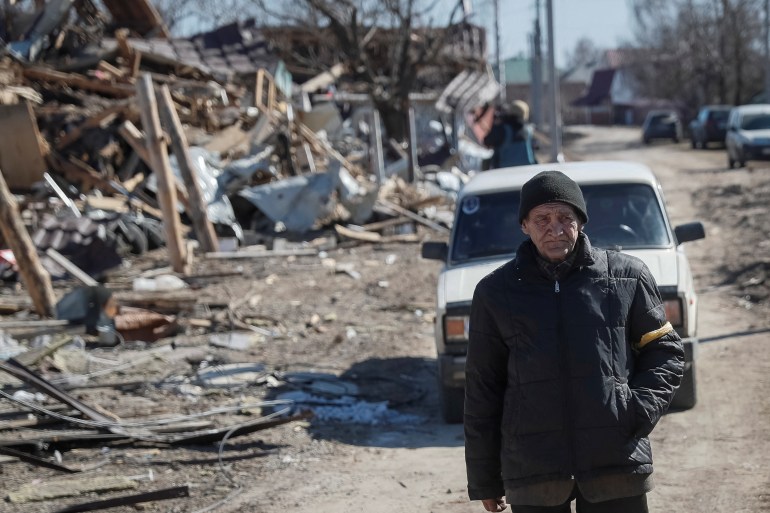
Final week, the UK’s defence ministry stated Russia’s army marketing campaign in Ukraine “has largely stalled on all fronts”, with President Vladimir Putin’s forces struggling losses and making minimal progress on land, sea or air.
That evaluation was in keeping with different current ideas from Western capitals, that Moscow, after nearly a month after launching an invasion on February 24, has missed its most important warfare targets.
Months earlier than attacking Ukraine, Russia had massed greater than 200,000 troops alongside the border.
The Kremlin anticipated the marketing campaign would go swiftly, and a few observers say Russia didn't put together for a protracted army battle by way of logistics, provides, the rotation of fight troops, and knowledge expertise.
“It does seem that the marketing campaign is experiencing larger problem than anticipated by way of development,” John R. Deni, analysis professor on the US Military Battle School’s Strategic Research Institute, instructed Al Jazeera.
“That is almost certainly the results of poor planning, poor morale, poor logistics, and the stiff resistance of Ukrainian forces.”
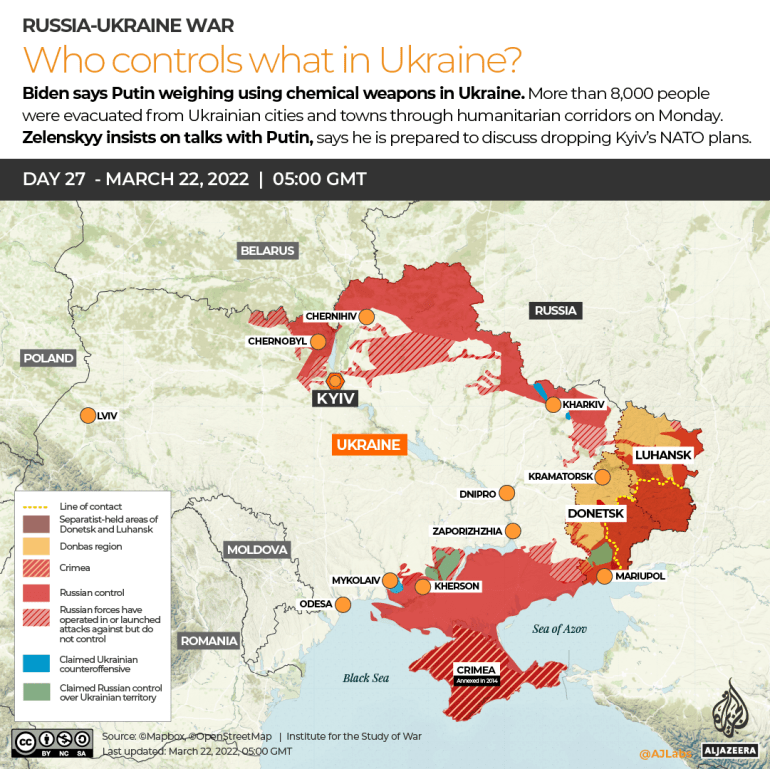
Certainly, Russia’s preliminary plans to wage a blitzkrieg have failed.
The present battle extra intently resembles the warfare between the Soviet Union and Finland in 1939-1940, when the advance of Soviet troops, having captured the insignificant border space, was shortly halted by the resistance of the defenders.
The UK’s defence ministry stated “Ukrainian resistance stays staunch and well-coordinated,” whereas “the overwhelming majority of Ukrainian territory, together with all main cities, stays in Ukrainian arms.”
In response to many Western analysts, Moscow underestimated Ukraine’s potential and readiness to battle.
Furthermore, “in a personalist dictatorship comparable to Putin’s, nobody has any incentive to contradict the chief as a result of their very own political and sometimes private survival depends upon his whims”, stated Alexander B. Downes, affiliate professor of political science and worldwide affairs on the George Washington College.
He instructed Al Jazeera: “Whether it is recognized that the chief favours an assault, who desires to be the one who contradicts him? On this regard, the Russian regime is just like Saddam Hussein’s in Iraq. Fed unhealthy data by his underlings solely will increase the chief’s confidence that he'll prevail, thus making it much more probably he'll assault.”
This mix of underestimating Ukraine and overestimating one’s personal capabilities could also be behind a few of Russia’s failures.
And a few analysts worry Moscow has been adapting its deliberate operations to this actuality – with extreme penalties, significantly for civilians.
“The Russian offensive seems to be stalled. There are a lot of reviews of provide and morale issues in Russian models. As a result of they're largely unable to advance – with a couple of exceptions, primarily within the south – they've fallen again on siege warfare and indiscriminate assaults on civilians,” stated Downes.
“Traditionally, it's common for attackers, when unable to win a fast and decisive victory on the battlefield, to develop into pissed off or determined and switch their weapons on civilians to weaken morale and compel their opponent to give up by means of a punishment technique. Punishing civilians, nevertheless, not often succeeds.”
However, Moscow has ample reserves to deploy, together with mercenaries and different Russian forces.
“It appears to me that in army phrases, they've achieved what known as ‘the fruits level’ the place they've exhausted what momentum that they had and might obtain no additional targets until they reset and resupply, which is undoubtedly what they're doing now,” Frank Ledwidge, former army intelligence officer and senior lecturer in technique on the College of Portsmouth, instructed Al Jazeera.
A reported lack of about 40 % of fight energy dedicated to Ukraine “represents an especially excessive stage of loss, and so they have actually sustained extra killed and injured in three weeks than the US and its allies have in 20 years of their operations in Iraq and Afghanistan,” stated Ledwidge.
“I believe that they are going to pause after which try to advance once more. This, after all, is topic to negotiations being unsuccessful. Certainly it appears logical that Russia will try to use extra strain on the Ukrainians exactly to strengthen their place in these negotiations.”
Nevertheless, in gentle of an obvious lack of progress, the West fears that Russia might resort to utilizing chemical weapons.
“Given the determined state of the Russian offensive, and Putin’s unwillingness up to now to scale back his warfare goals even within the face of huge losses, chemical weapons use shouldn't be out of the realm of risk.
“It depends upon how Putin weighs the short-term army benefit versus the doable Western response. I'd put the probability of chemical weapons use at lower than 50-50, however [that] will increase if the stalemate continues,” stated Downes.
Chemical weapons would mark the subsequent stage of escalation.
“There are a lot of difficulties with utilizing chemical weapons in fight. One’s personal forces, for instance, should don cumbersome chemical gear. It might additionally take time to get the weapons to the entrance. And the worldwide response could be extreme; in contrast to in Syria, I'd count on additional escalation from the US/NATO if Russia used chemical compounds,” Downes stated.
“That stated, chemical weapons could possibly be extremely efficient till Ukrainian troops developed countermeasures, probably with NATO help. The benefit would thus be short-term.”
The principle victims of chemical weapons, after all, could be the overall inhabitants.
“Sadly, the identical can't be stated about Ukrainian civilians. As we noticed in [Syria’s] Ghouta in 2013, the consequences of chemical weapons on civilians could be extraordinarily lethal. If the Russians attacked Ukrainian cities with massive portions of chemical weapons, it might inflict mass casualties. Nevertheless, given the ache these cities have endured, it's unclear whether or not it might drive them to capitulate,” stated Downes.
Contemplating the primary weeks of warfare and the Russian establishment in Ukraine, with all its failed targets, Putin’s current comment that each one was “going to plan” is seen by many as pure Russian propaganda.
“I believe Putin’s feedback are meant fully for home consumption, as a part of a broader propaganda effort inside Russia,” Deni stated.
Actually, Ledwidge concluded there was “no resemblance between what has occurred and the ‘plan’ the Russians had which was primarily based on astonishingly misguided assumptions; not least that the fight portion of the operation would take two days, and that Ukrainian resistance would collapse shortly.”

Đăng nhận xét for "Has Russia’s offensive really ‘stalled on all fronts’ in Ukraine?"